
Validation
Evidence, by tier
Every claim on this page is labeled by what kind of evidence it is — real telemetry, public-dataset characterization, simulation-supported research, or not yet available — so nothing here overstates what's been measured.
Real telemetry, measured
A single lab-operated reference link, continuously collected, carrying two recorded incidents end to end.
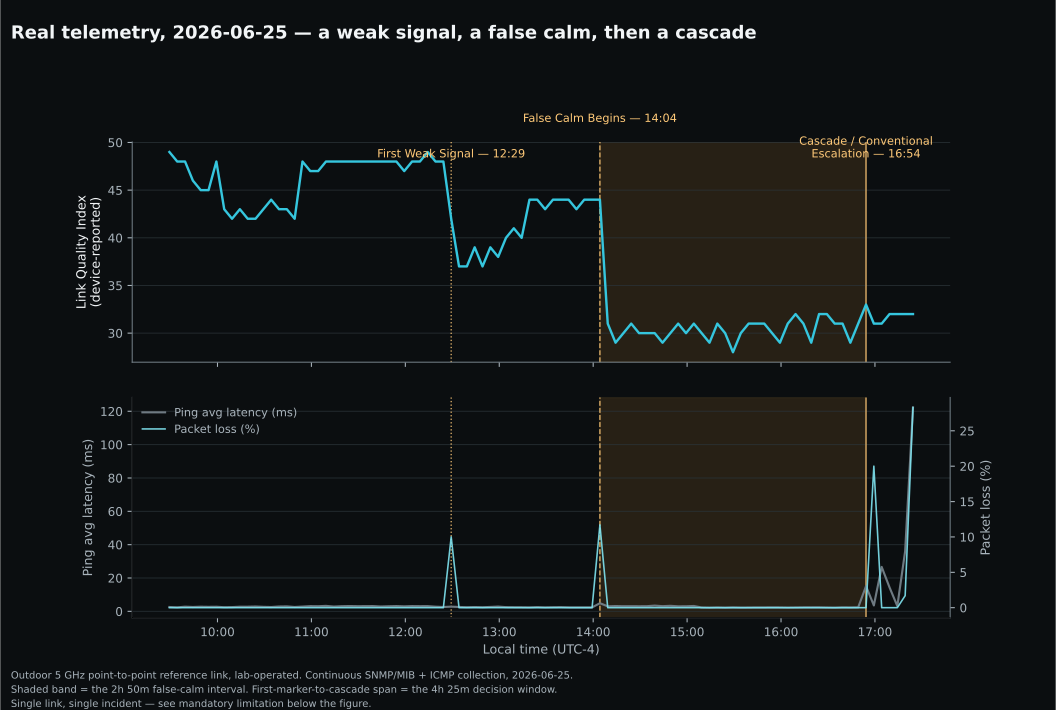
Outdoor 5 GHz point-to-point reference link, lab-operated. Continuous SNMP/MIB + ICMP collection, 2026-06-25 — the incident behind the figures below. Link Quality Index (top) degrades hours before ping latency or packet loss (bottom) show anything a threshold-based monitor would flag.
Mandatory limitation
Single link, single incident. Enough to demonstrate the mechanism end to end. Not yet enough to claim detection accuracy — multi-link validation is the pilot objective.
4h 25m — Decision Window
First weak signal to cascade escalation.
2h 50m — False Calm
Conventional monitoring reported healthy while degradation was underway.
2 Recorded Incidents · 144 Collection Cycles · 1 Production-Representative Link
Continuous SNMP/MIB collection from an outdoor 5 GHz point-to-point reference link, lab-operated. The collector is standard SNMP/MIB — the same path reads carrier microwave network elements.
Specificity Check
The same unmodified reasoning, run on a deliberate load test on the same link, identifies traffic-induced saturation rather than radio degradation.
Resource envelope
103 MB peak resident memory — 1.4% of an 8 GB edge node.
Measured on an NVIDIA Jetson Orin Nano Developer Kit (8 GB) against a 2,500-row demonstration dataset. Behaviour at operator scale is not measured.
Third-party datasets, characterized — not validation
PMADS, SNOB5G and SIAE are third-party public research datasets, characterized to sharpen the telemetry request Velorona makes of an operator. No Velorona system has run against them.
Simulation supports algorithm development — it is not evidence
Algorithm development is supported by a standards-informed, physics-based simulation environment. For point-to-point microwave this is derived from ITU-R propagation models. It is not calibrated against operational data, and no validated claim rests on it.
See the simulation research on AID Edge Research →Operator pilot — not yet available
No operator-network results yet. A read-only historical replay is how we get them.