
Platform
Operational Outcomes Before Escalation
Velorona.ai turns fragmented telemetry into earlier, actionable decision signals for network operations and critical infrastructure — helping teams move sooner, reduce uncertainty, and intervene before instability escalates into costly service impact.
Operational outcomes, measured
Operational Signal Clarity
Separates meaningful instability from background variability, improving signal clarity before unnecessary escalations begin.
Earlier Decision Timing
Surfaces meaningful degradation earlier, helping teams move from uncertainty to action before service impact builds.
Avoidable Escalation Reduction
Distinguishes transient instability from conditions that truly require action, reducing unnecessary escalations.
Service Risk Visibility
Identifies hidden service risk earlier, supporting stronger service continuity and clearer prioritization.
How Velorona Creates Earlier Decision Time
Measured through two core operating metrics.
Operational Decision Lead-Time
The time between the first meaningful deviation in network behavior and the point at which an operator can make a stable, defensible decision. Conventional monitoring's own lag comes from configured smoothing and persistence delays, not physical limits — which is why this window exists at all, and why it can be recovered from telemetry the network already produces.
Operational Lead Time
The usable time window gained for operations teams to assess risk, coordinate response, and act before service impact builds — shifting response from reactive firefighting to earlier, lower-stress intervention.
Mechanism
From telemetry to an earlier operational decision
- 01
Telemetry
Existing network signals — read-only, no new sensors required.
- 02
Correlation
Checked against each element's own historical baseline, not a generic threshold.
- 03
Degradation Pattern
Sustained deviation distinguished from normal variation.
- 04
Decision Boundary
Corroborating evidence confirmed before anything is treated as decision-grade.
- 05
Earlier Operational Decision
The operator acts within the decision window — before conventional alarms trigger.
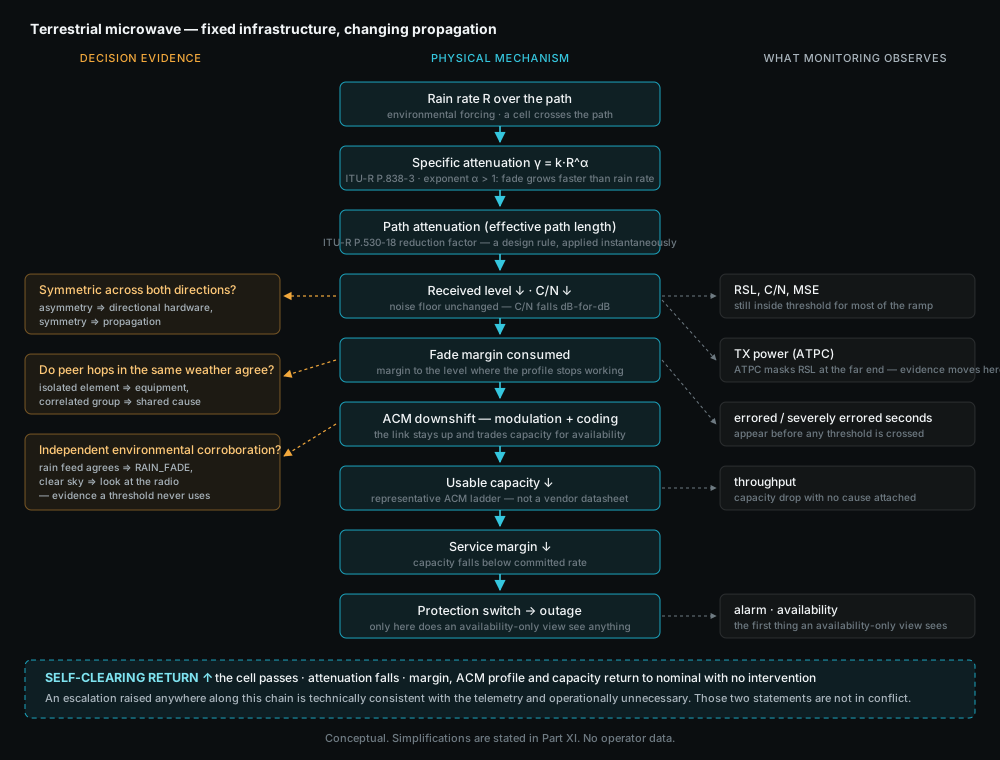
How a propagation change becomes an operational event. Blue: physical mechanism. Grey: what monitoring observes. Amber: decision points.
Why Signals Look Calm
The gap between the surface and the signal
Adaptive coding and modulation (ACM) and automatic transmit power control (ATPC) are designed to preserve link availability as conditions change — which means the indicators operators watch first, availability and alarm status, can stay quiet even as the margin protecting the link is being consumed. The link stays up. Traffic keeps flowing. Nothing on the alarm list changes. That gap between what's visible at the surface and what's happening underneath is where early degradation goes unseen by threshold-based monitoring. This is exactly what ATPC does to the evidence trail: it moves the signal of degradation out of received signal level (RSL) and into TX-power telemetry, since the radio is actively compensating rather than reporting a falling RSL directly.
Decision-Grade Signal Qualification
Telemetry is qualified before it becomes intelligence
Standards-Based Validation
Incoming telemetry is validated against operationally valid ranges derived from 3GPP and related telecom standards.
Noise Is Not Ignored
Out-of-standard data is tracked, not discarded — its frequency, variance, and recurrence expose early instability patterns.
Edge-Level Discipline
Qualification happens at the edge, before aggregation or alerting, reducing noise propagation and preserving decision integrity.
Where Velorona Fits in the Stack
Wireless Networks (RAN & Core)
Earlier instability detection and pre-escalation decision support across complex wireless operations.
Fiber & Access
Decision support where fragmented telemetry and delayed impact make early intervention harder to justify.
Edge → Cloud
Edge-native inference for low-latency prediction with centralized visibility and operational control.
Satellite & NTN (Roadmap)
Roadmap alignment toward satellite-linked and non-terrestrial operations using the same decision-layer principles.
Every signal shown here stays read-only and out-of-band — see the full operational boundaries on Deployment.